


For decades, construction safety meant learning from what already went wrong. An incident occurred, a report was filed, and changes followed. That cycle has saved lives, but it always lags the hazard. Predictive safety construction aims to move that response earlier. It uses tools such as wearables, environmental sensors, connected gas monitors, cameras, and mobile reporting platforms to help crews and supervisors spot changing risks before they become injuries or emergencies.
The timing matters. On October 5, 2026, ABC National released its sixth annual technology report focused on proactive safety technology, and Construction Executive covered the same development for the industry audience. The message is clear: contractors are paying more attention to technology that can strengthen field visibility, enable faster response, and improve how safety information moves across the jobsite.
This article is a practical decision guide for Eastern Pennsylvania contractors. It explains which predictive safety tools are worth evaluating now, how to pilot them without overwhelming crews, and how to connect them to the safety systems you already use. ABC Eastern Pennsylvania’s safety resources, STEP participation, and ABC-OSHA Partnership with area offices in Allentown, Philadelphia, and Wilkes-Barre can help member firms evaluate options and strengthen implementation.
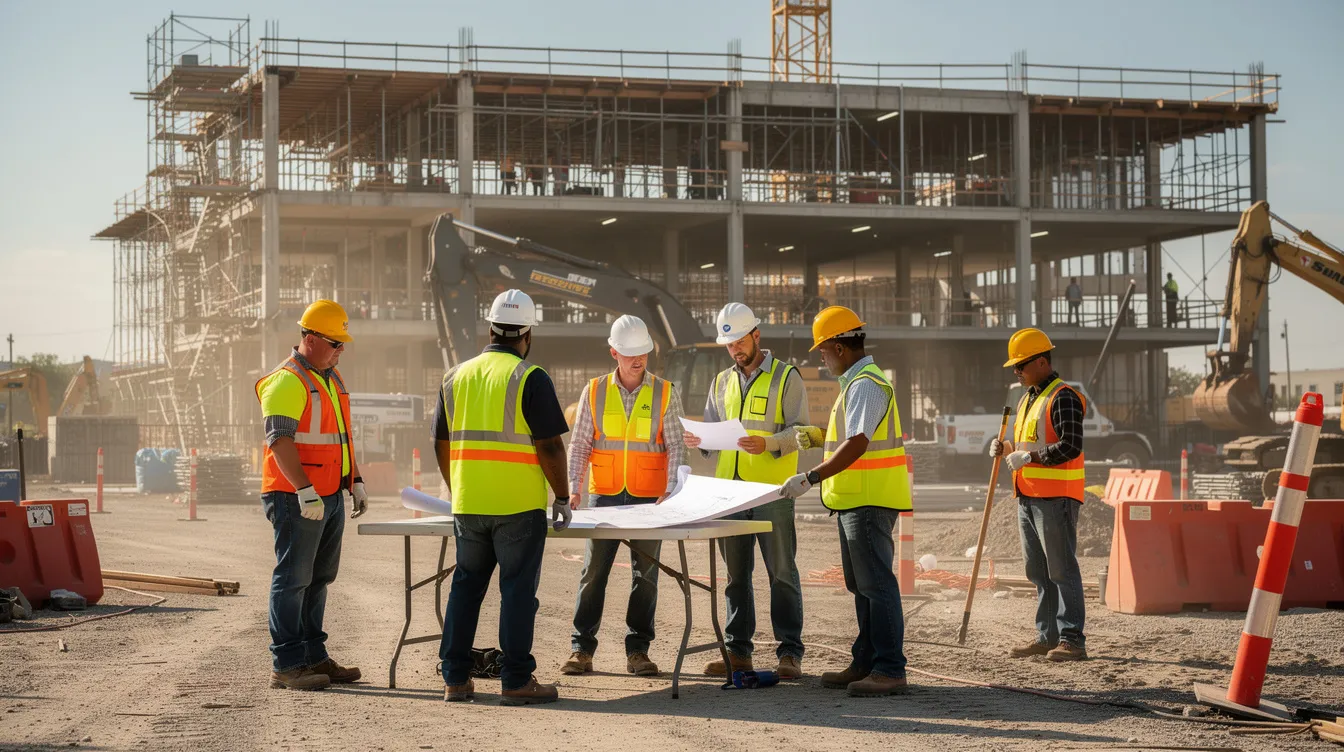
Traditional safety practices still matter. Inspections, job hazard analyses, pre-task planning, incident investigations, training, and PPE enforcement remain the foundation of a strong safety program. Predictive safety construction does not replace those controls. It adds a more continuous stream of information that can help teams recognize changing conditions sooner.
Instead of relying only on a point-in-time observation, safety leaders may also receive alerts or trend data from wearables, environmental sensors, smart PPE, connected gas monitors, drones, or mobile safety apps. That can help teams notice repeated near-misses, rising heat exposure, equipment-worker proximity issues, or environmental changes that deserve action before someone gets hurt.
Consider a practical example: a proximity alert warns a ground worker when equipment enters an unsafe zone, or a wearable flags signs of rising heat strain during a hot and humid shift. The value is not the device by itself. The value is the combination of earlier warning, a defined response plan, and field leaders who know what to do next.
That is the real shift. Predictive safety construction moves safety management from “What happened?” toward “What is developing right now, and what should we change before this turns into harm?”
Not every technology demo belongs on an active jobsite. But several categories are far enough along that Eastern Pennsylvania contractors can evaluate them now for real field use.
Wearable technology can include watches, tags, connected vests, helmets, and eyewear. NIOSH has noted that wearables in construction may support functions such as proximity detection, physiological monitoring, heat-stress warning, and environmental sensing.
Environmental sensors can monitor conditions such as temperature, humidity, air quality, noise, and atmospheric hazards. Connected gas monitors can provide faster alarms for oxygen deficiency or hazardous gases in the right applications. Mobile safety and inspection apps can digitize pre-task planning, observations, and near-miss reporting so issues move more quickly from the field to supervision.
Beyond those tools, some contractors are also evaluating drones for remote visual review, BIM-enabled planning to identify coordination and access concerns before work begins, and AI-assisted software to sort large volumes of safety or field data. These tools should be reviewed carefully. Their usefulness depends less on marketing claims and more on whether they improve a real field decision, fit the workflow, and produce information your team will actually use.
Wearables are often the first predictive safety tool contractors pilot because they map to visible exposures such as heat, falls, proximity risks, and worker accountability. NIOSH has reported that wearable construction devices can take forms such as clothing, watches, helmets, and eyewear, and that costs can range from roughly $35 for simple Bluetooth-based devices to more than $1,000 for more complex systems.
Common examples include smartwatches, wristbands, connected safety vests, smart helmets, and connected eyewear. Depending on the system, these tools may support location awareness, environmental monitoring, proximity alerts, or physiological warning functions. That does not mean every device belongs on every project. The better question is which exposure you are trying to manage and whether the device helps supervisors make a better decision in time to matter.
Smart helmets and connected head protection are getting attention because they may combine core PPE with added features such as communication, gas detection, or proximity warning. Some systems also aim to place alerts directly in the worker’s line of sight or field workflow. As with any PPE-related technology, practical adoption matters more than the feature list.
Comfort and compatibility are major adoption issues. If a device interferes with existing PPE, is too bulky, or cannot last through the shift, workers are unlikely to keep using it. That is why fit matters here too. The same field reality that affects prescription safety glasses adoption also applies to connected safety gear: if workers cannot wear it comfortably alongside the rest of their PPE, the technology may never become part of the job.
Some contractors are also watching exoskeletons and strain-reduction devices for tasks involving repetitive lifting, kneeling, or overhead work. These remain more emerging than routine on most jobsites, but they are part of the broader conversation about proactive safety technology and worker support.
Environmental sensors can help monitor conditions that workers may notice too late on their own, such as worsening air quality, rising heat exposure, changing confined-space conditions, or elevated noise. For Eastern Pennsylvania contractors, that matters across very different work settings: open summer jobsites in the Lehigh Valley, dense urban renovation work in Philadelphia, and remote highway or utility work in Northeast Pennsylvania.
On hot-weather projects, sensors may help teams recognize when conditions are becoming more dangerous before a worker shows visible symptoms. NIOSH heat-stress guidance recommends engineering and administrative controls such as limiting time in the heat, increasing recovery time in a cool area, planning acclimatization, and using hydration and work-rest strategies. A sensor does not replace that planning. It can help reinforce when action is needed.
Inside older buildings or enclosed work zones, portable or fixed monitors may also help identify air-quality or atmospheric concerns sooner than periodic checks alone. On larger or more dispersed sites, environmental monitoring can give safety leaders visibility they can’t get when they can’t be in every zone at once.
The key is response. Continuous monitoring only helps when alert thresholds, communication paths, and corrective actions are already defined.
On a jobsite, when teams use predictive tools well, safety data doesn’t just sit in software. It feeds daily operations. A superintendent may review heat conditions before the morning huddle, look at recurring proximity alerts from the previous day, or adjust a pre-task plan based on changing site conditions.
That kind of workflow can change decisions in practical ways:
That is why predictive safety works best when it supports the existing safety process rather than creating a separate technology track. Alerts should inform toolbox talks, pre-task planning, supervisor walkthroughs, and corrective-action decisions. If the field team does not trust the information or cannot act on it easily, the technology becomes noise instead of value.
Eastern Pennsylvania contractors operate across a broad mix of site conditions. The strongest use cases for predictive safety often depend on the type of work and the logistics challenges in each submarket.
| Region | Typical Project Conditions | Predictive Safety Priorities to Evaluate |
|---|---|---|
| Philadelphia / Collar Counties | Urban infill, renovation, institutional work, tighter logistics | Worker-location awareness, camera review, proximity alerts, faster mobile reporting |
| Lehigh Valley / I-78 Corridor | Warehouse, distribution, industrial, large open sites | Heat and environmental monitoring, hydration-related planning support, sitewide visibility tools |
| Northeast Pennsylvania / I-81 Corridor | Highway, utility, logistics, remote or dispersed crews | Location tracking, remote monitoring, environmental alerts, emergency-response visibility |
Philadelphia’s tighter sites can make worker-equipment interaction and congestion more urgent. Lehigh Valley projects often create broad-area visibility challenges in summer heat or winter cold. Northeast Pennsylvania work can add distance, terrain, and remote-response concerns that make location and environmental awareness more valuable.
That does not mean every contractor needs the same technology stack. It means the right pilot should match the field condition creating the most risk or the weakest visibility.
The fastest way to waste money on safety technology is to buy a broad platform first and look for a problem later. A better approach is to start with one exposure, one project, and one measurable objective.
A practical pilot framework looks like this:
Evaluate each tool against field reality: glove-friendly use, battery life, durability, signal reliability, alert clarity, and fit with your current workflow. Be careful about alert volume. If alarms are constant, unclear, or routed to the wrong people, crews will start ignoring them. The best pilot is usually the one with the simplest rules.
Data handling matters too. If a vendor is collecting location, biometric, or field-performance data, your team should understand what is being collected, who can access it, how long it is retained, and how it will be used.
Even useful technology can fail if workers see it mainly as surveillance. NIOSH has documented worker concerns around wearable devices, including discomfort, privacy, and uncertainty about how collected data may be used. Those concerns are not side issues. They directly affect adoption.
Before deployment, explain what the tool monitors, what it does not monitor, who can view the data, and how the information supports safety decisions or emergency response. Keep the message specific. Vague assurances usually create more skepticism, not less.
Practical ways to improve buy-in include:
When crews understand the purpose, see a clear field benefit, and know the tool is not being introduced carelessly, adoption becomes more realistic.
Predictive safety construction adds value only if it improves how your company manages risk. More data alone is not a win. You need to know whether the pilot changed decisions, responses, or outcomes in a useful way.
Track a focused group of metrics tied to the pilot goal:
| Metric | What It Can Show |
|---|---|
| Number of relevant alerts | Whether thresholds are meaningful or too sensitive |
| Supervisor response after an alert | Whether the team is acting on the information |
| Near-miss reporting tied to the target hazard | Whether visibility and reporting are improving |
| Worker feedback on comfort and usefulness | Whether adoption is realistic at scale |
| Changes in targeted incidents or exposures | Whether the tool appears to support safer field performance |
Give the pilot enough time to produce usable trend information based on project duration, exposure frequency, and the type of hazard involved. Then review the results honestly. Some tools should scale. Others should be adjusted. Some should be abandoned. That is not failure. It is the point of a pilot.
ABC Eastern Pennsylvania’s safety support, STEP participation, and consulting resources can also help contractors evaluate whether a new tool strengthens the broader safety management system rather than distracting from it.
If your company wants to move from interest to action, the next step is not buying every new platform that promises predictive insight. It is choosing one field problem and evaluating one practical response.
ABC Eastern Pennsylvania can support that process through its safety programs and consulting resources. Contractors that want broader chapter support can also review membership benefits for access to training, workforce development, events, and industry resources.
The larger takeaway is simple. Predictive safety construction is not about replacing field leadership with gadgets. It is about improving visibility, response, and decision-making on jobsites where conditions change fast, and hazards rarely wait for paperwork. The contractors that get the most value from these tools will be the ones that start small, measure honestly, and build technology into the safety culture they already expect from the field.


