


The Theodore Roosevelt Presidential Library opened in Medora, North Dakota, on July 4, 2026, marking the 250th anniversary of the United States. For contractors and project managers, it offers a timely case study in historic landmark construction under conditions that leave little room for error: a fixed public deadline, high design expectations, demanding sustainability targets, and unusual material choices. As the project team reported in March 2026, the library was already more than 95% complete and entering its final construction phase. Construction Executive highlighted the project during construction, and the completed library now gives Eastern Pennsylvania contractors a concrete example of how landmark work gets delivered when schedule pressure, public visibility, and technical ambition converge.
For ABC Eastern Pennsylvania members, the value is not in admiring a one-of-a-kind project from a distance. It is in identifying the delivery disciplines that also matter on institutional, civic, higher-education, and cultural projects across Philadelphia, the Lehigh Valley, and Northeast Pennsylvania. Landmark work raises the stakes on coordination, sequencing, craft quality, safety, and stakeholder alignment. The Theodore Roosevelt Presidential Library shows what that looks like in practice.
The library sits on a 93-acre site adjacent to Theodore Roosevelt National Park and was designed to blend into the surrounding Badlands landscape rather than dominate it. Public project materials describe the facility at roughly 95,000 to 96,000 square feet, with an accessible living prairie roof spanning about 121,000 square feet. Snøhetta expects more than 200,000 visitors annually.
The building’s design and construction stand out because the structure is not only a museum or archive. It is also part landscape, part public experience, and part sustainability demonstration. The project team used rammed earth as a defining architectural material and paired it with a hybrid structural approach that included steel and mass timber. Mercer Mass Timber states that it supplied 2,615 cubic meters of CLT and glulam for the project.
The sustainability ambition was equally prominent. Project descriptions consistently frame the library as pursuing highly demanding environmental performance goals, with public materials emphasizing regenerative design, an accessible living roof, native prairie restoration, and ambitious certification goals. That combination is exactly what makes the project useful to study as historic landmark construction: the building had to perform as architecture, narrative, destination, and technical system at the same time.
A typical commercial building can be difficult enough to deliver. A landmark project adds another layer: the building itself becomes part of a public story. That changes the consequences of design decisions, finish quality, sequencing, and schedule control.
On a standard office or warehouse build, success may be judged mainly by budget, function, and completion date. On a landmark, owners and the public often expect the building to express values. In this case, the Theodore Roosevelt Presidential Library was expected to reflect conservation, place, and permanence in visible ways. That meant materials, roof design, circulation, and site integration all carried symbolic weight as well as technical requirements.
This is where historic landmark construction differs most from ordinary work. The project team is not simply coordinating trades. It translates an institution’s identity into assemblies that can be built, protected, inspected, turned over, and maintained. When that translation fails, the problem is visible not only to the owner, but also to donors, visitors, media, and the broader public.
For Eastern Pennsylvania contractors, that lesson applies well beyond presidential libraries. A university building in the Lehigh Valley, a civic facility in Philadelphia, or a cultural project in Northeast Pennsylvania can produce the same dynamic. Once a project carries institutional meaning, every exposed surface and every missed coordination decision matters more.
The library illustrates how landmark work multiplies delivery risk. A fixed July 4, 2026 opening date meant the schedule was never just an internal milestone. It was a public commitment. Missing that kind of date does more than disrupt operations; it creates a visible failure.
The project also required coordination across a wide mix of participants, including design leadership, construction management, landscape design, specialty suppliers, and installation teams working toward a highly specific architectural outcome. Even without relying on unsupported technical detail, the finished building’s visibility makes clear that early mockups, tight submittal control, and disciplined sequencing would have been essential. That is a reasonable delivery inference from the project’s complexity, not a claim about one unpublished schedule document.
The structural and material strategy added another layer of complexity. Publicly available project descriptions identify mass timber as a significant component of the building and frame the architecture as deeply integrated with the surrounding site. Rammed earth also served as more than a finish material. It became part of the building’s identity, which means tolerances, protection, moisture management, and sequencing carried outsized importance during construction.
That matters because unusual materials don’t just create design interest. They change risk. Once a project includes highly visible specialty assemblies, project teams have fewer opportunities to hide imperfections, absorb late redesign, or recover casually from sequence mistakes.
Landmark projects usually involve more than one definition of success. The owner may care about mission. Donors may care about public legacy. Designers may care about architectural integrity. Operators may care about maintainability. Contractors need all of those priorities translated into decisions that can be priced, scheduled, and installed.
That is one of the most practical lessons from the Theodore Roosevelt Presidential Library. The project’s public identity was tied to conservation, landscape, and visitor experience. Those are powerful ideas, but they only help the field when they are converted into buildable scope: roof assemblies, planting plans, structural interfaces, waterproofing details, finish expectations, turnover definitions, and inspection standards.
For Eastern Pennsylvania contractors, this is the point where many high-visibility projects either gain control or lose it. If decision rights are unclear, field teams end up waiting on aesthetic calls that affect procurement, access, enclosure, and labor planning. If multiple stakeholders believe they can reopen choices late, the result is familiar: rework, change-order friction, compressed durations, and strained trade relationships.
Contractors bidding civic and institutional work in Philadelphia, the suburban counties, the Lehigh Valley, or Northeast Pennsylvania should treat stakeholder mapping as a preconstruction task, not an owner-side formality. Clarify who can approve material changes, who owns sustainability documentation, who resolves conflicts between design intent and constructibility, and what level of mockup review is required before production begins.
The strongest operational takeaway is sequencing discipline. Buildings that combine specialty materials, landscape integration, and public opening pressure cannot be managed with casual phase logic. They require explicit dependency planning.
At a project like this, enclosure timing affects interior progress. Roof readiness affects landscape installation. Specialty finishes affect turnover to exhibit or occupancy teams. Weather-sensitive work can narrow the recovery options available later in the job. Even without repeating unsupported quantities, the library’s completed form shows a project where sequencing errors would have compounded quickly.
That has direct relevance for Eastern Pennsylvania contractors. Firms working winter conditions along the I-81 corridor, dense institutional sites in Philadelphia, or multi-phase campus work in the Lehigh Valley already know that structure, weather, access, and turnover milestones can destabilize a schedule fast. The lesson from the Theodore Roosevelt Presidential Library is that transitions between systems deserve as much planning as the systems themselves.
That is also why mockups, hold points, and phased turnover matter so much on landmark work. When a project includes highly visible exterior assemblies, unconventional roof systems, or museum-grade public interiors, the safest time to identify conflicts is before production spreads across the jobsite.
Contractors familiar with temporary bracing lessons on complex structural work will recognize the same principle here: every temporary condition and every transition state needs a plan before the team reaches it in the field.
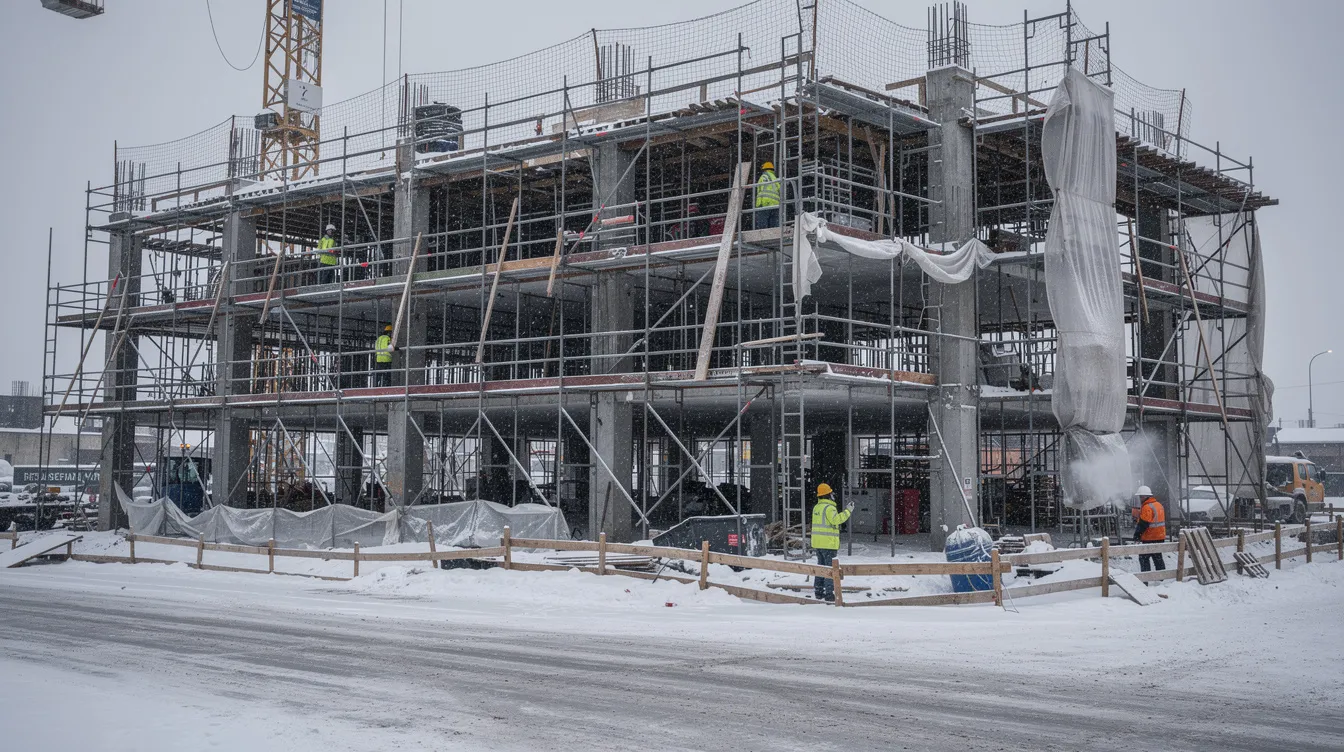
Landmark projects expose the relationship between workforce capability and project risk. A design-driven building with specialty materials, visible finishes, and public scrutiny cannot be delivered by labor availability alone. It depends on trained field leadership, qualified specialty installers, and strong safety execution under pressure.
That principle is familiar across ABC Eastern Pennsylvania’s territory. Whether the work is a civic renovation in Center City, a healthcare expansion in the suburbs, a higher-education project in the Lehigh Valley, or a specialized institutional build in Northeast Pennsylvania, the best-performing firms usually pair preconstruction discipline with field capability.
Safety expectations rise on projects like this because technical ambition creates more exposure, not less. Irregular roof conditions, public-facing site logistics, specialty structural elements, weather-sensitive materials, and tight finish tolerances all increase the need for planning and supervision. A landmark opening date can never excuse rushed sequencing or weakened controls.
That is where training matters. ABC Eastern Pennsylvania’s apprenticeship and craft training programs, along with broader management and safety resources, speak directly to the capabilities these jobs require. High-visibility institutional work rewards firms that already know how to coordinate complex scopes, maintain quality under scrutiny, and keep jobsites safe when schedule pressure rises.
The direct local value of this case study is not that Eastern Pennsylvania will build a copy of the Theodore Roosevelt Presidential Library. It is that the same delivery pressures appear here in different forms.
Philadelphia and the suburban counties regularly generate projects with dense stakeholder groups, difficult logistics, and public visibility. The Lehigh Valley continues to see institutional and campus work where identity, schedule, and sustainability can all shape scope. Northeast Pennsylvania contractors may face fewer headline projects, but they still encounter civic, education, healthcare, and regional-development work where coordination mistakes become highly visible.
If you are pursuing that kind of work, a few practices matter early:
The broader Eastern Pennsylvania construction outlook remains useful context here: firms that want more complex, higher-visibility work need internal systems that can support it. Schedule ambition alone is not a strategy.
Before committing to a project with the same kind of delivery pressure seen at the Theodore Roosevelt Presidential Library, ask:
Who has final authority on visible design changes after construction starts?
Landmark projects often blur the line between design refinement and scope change. Define that line early.
Which assemblies have the least tolerance for rework?
Identify the materials or systems that are most exposed to public view, most sequence-sensitive, or most difficult to replace once installed.
What deadlines are truly non-negotiable?
Treat public openings, academic calendars, donor commitments, and occupancy events differently from ordinary target dates.
What must be turned over in phases?
On complex public projects, one zone may need to be complete for exhibits, operations, or commissioning while other areas are still active.
Do we have the craft capability and supervision depth this job requires?
If the answer depends on learning specialty execution in the field, the pursuit decision deserves another look.
Where could weather, material lead times, or specialty fabrication collapse our float?
That question matters in Medora, and it matters just as much in Eastern Pennsylvania when work depends on seasonal conditions or tight procurement windows.
For contractors that want to strengthen that readiness, construction training programs and ABC Eastern Pennsylvania membership can support the workforce development, peer learning, and safety systems that make more demanding projects manageable.
The Theodore Roosevelt Presidential Library is a useful example of historic landmark construction because it puts multiple pressure points in one place: a fixed public opening date, a highly visible architectural vision, demanding environmental expectations, and little room for coordination failure.
For Eastern Pennsylvania contractors, the takeaway is practical. The firms best positioned for institutional and civic work are not just the ones willing to bid it. They are the ones prepared to control scope, protect sequence, manage stakeholders, support field leadership, and maintain safety when the project is too visible to hide mistakes.
If your company wants to compete for more complex work across Philadelphia, the Lehigh Valley, or Northeast Pennsylvania, use this case study as a benchmark. Review your preconstruction process, turnover planning, specialty-assembly controls, and workforce readiness now. The next landmark-style project will reward the firms that prepared before the bid arrived.


