


This article focuses on a specific use of construction technology: virtual reality in product design and testing before a tool, platform, or piece of equipment reaches a live jobsite. It is not a general overview of headsets in the field. It is a practical briefing on how construction technology virtual reality can improve the products Eastern Pennsylvania contractors are asked to buy, install, and trust.
Consider a familiar scenario. A contractor in Philadelphia, the Lehigh Valley, or Northeast Pennsylvania sits through a vendor demo for a new jobsite platform or a redesigned piece of field equipment. The sales team says the product was refined in virtual reality. That may sound impressive, but the better question is simpler: what did virtual reality actually help the manufacturer learn before rollout?
The strongest answer is not that VR made the product look polished. It is that VR helped designers and product teams review scale, access, ergonomics, workflow, and usability early enough to change the design before physical prototypes or field installs made those mistakes expensive. As Construction Executive reported in October 2026, Milwaukee Tool uses virtual reality in product development to evaluate ideas, spot potential challenges, and make better decisions before building physical prototypes.
That helps contractors because it changes how you evaluate vendor claims. A product pressure-tested in a virtual environment may enter pilot use with fewer obvious design problems. But VR is still an early decision aid, not proof that a product is fully validated under real jobsite conditions.
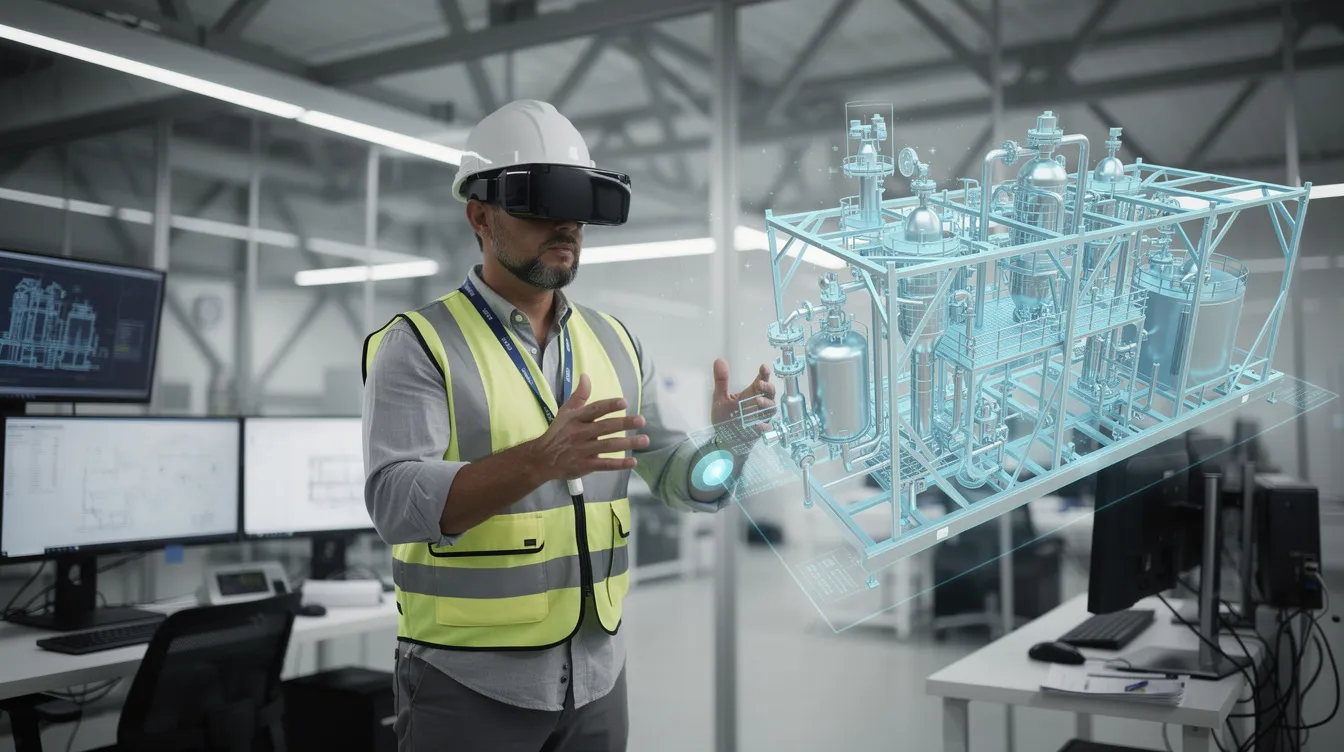
Most contractors already work around digital models. Drawings, 3D files, and BIM-based coordination are standard parts of modern preconstruction and project planning. Virtual reality changes the sense of scale and interaction. Instead of viewing a product on a screen, designers and reviewers can experience it at human scale inside an immersive model.
That matters when the product must function in tight, messy, equipment-heavy environments. A control location that looks reasonable on a monitor may feel awkward when someone in VR has to reach for it. A display that appears readable in a rendering may be too small or poorly placed when viewed as if it were mounted in an actual work area.
For construction technology virtual reality, the practical value is early testing of things that are easy to miss in flat reviews:
Construction Executive’s October 22, 2026 article frames VR in exactly that role: a tool that helps product teams experience and evaluate designs earlier in development, before physical prototypes are built. That is a narrower and more useful claim than the broad marketing language contractors often hear around immersive technology.
Traditional design reviews still matter, but they do not always expose human-use problems clearly enough. VR can help surface those issues sooner.
For example, immersive review may reveal that a service panel is technically accessible but awkward for a user wearing gloves. It may show that a screen is blocked from the angle where a foreman or operator would normally approach it. It may also expose workflow bottlenecks, such as several people needing to occupy the same cramped area to read, reset, inspect, or maintain a device.
Those are not abstract design concerns. They are the kinds of small misses that later create field workarounds, extra training, relocation requests, or resistance from crews who have to live with the product after purchase.
VR can also improve review quality by giving more stakeholders the same visual reference. Instead of one group interpreting drawings and another group reacting to a late prototype, designers, operations leaders, safety reviewers, and field advisors can react to the same full-scale scenario much earlier. That does not guarantee agreement, but it can make disagreement more specific and useful.
For Eastern Pennsylvania contractors, that is where the value becomes practical. Whether the eventual project is a dense Philadelphia renovation, a warehouse build along the I-78 corridor, or a distributed industrial or infrastructure job in Northeast Pennsylvania, the question is the same: did the vendor use VR to identify real-world friction before the product reached your site?
Modern product development often works in loops. A team develops a concept, reviews it, revises it, and tests it again before building or releasing the next version. VR can strengthen that loop by making early feedback more concrete.
Instead of waiting for a physical mockup, teams can make changes after seeing how a layout, interface, or piece of equipment behaves in a simulated full-scale review. That can help them catch issues before they become more expensive to fix in fabrication, installation, or software rollout.
For buyers, the business implication is straightforward. Products shaped by serious early review may arrive with fewer obvious usability mistakes. That does not mean they are automatically better in every respect. It means they may be less likely to force avoidable corrections after procurement or during a pilot install.
That distinction matters on active construction projects. A contractor does not just buy a tool. The contractor absorbs the operational cost of poor design: retraining, disrupted workflow, field improvisation, coordination delays, and sometimes rework. Earlier design feedback helps reduce the odds of those problems showing up for the first time on your jobsite.
VR has limits, and contractors should keep them in view. It does not replace physical testing, jobsite pilots, durability evaluation, or field feedback from actual users.
No virtual review fully reproduces dust, vibration, glare, weather, moisture, noise, congestion, shifting access conditions, or the distraction level of an active jobsite. It also cannot settle every question about durability, maintenance burden, battery life, hardware resilience, or long-term crew adoption.
That is why the most credible version of the vendor claim is not “designed in VR,” but “reviewed in VR, then validated through physical testing and field use.” Construction Executive’s source article makes that distinction clearly: virtual reality strengthens development by improving decisions earlier, but it does not replace physical testing.
That limit also matters in training conversations. OSHA addressed virtual reality safety and health training in an interpretation letter dated August 10, 2020, and emphasized that compliance depends on whether the training used is adequate for the applicable standard and situation. In other words, VR can be part of a training approach, but it does not automatically satisfy every requirement.
For contractors, the takeaway is simple: treat VR as evidence of earlier design review, not as proof that a product is fully proven under field conditions.
Virtual reality, augmented reality, and mixed reality are related, but they do different jobs. VR places the user inside a fully digital environment. AR and mixed reality place digital information into the user’s view of the real world.
In practical terms, VR is often most useful earlier in design and product review. AR or mixed reality may matter later, when crews install, verify, or interact with information on a real site. The categories overlap, but they are not interchangeable.
For contractors evaluating a product, the useful question is not which acronym a vendor prefers. It is whether the product moved through a disciplined process from early design review to real-world validation. If the same company talks about VR in development and AR or mixed reality in deployment, ask how those stages connect and what was actually learned at each one.
That keeps the conversation focused on product quality rather than on buzzwords.
Not every headset demo reflects a serious design process. Some are marketing theater. Others show that meaningful review happened before release. Contractors should know the difference.
Here are better indicators that a vendor used construction technology virtual reality in a substantive way:
Weak answers are usually easy to spot. If “VR-designed” only means the vendor made a compelling demo environment, the practical design value may be thin. If the vendor can point to what changed because of immersive review, that is more meaningful.
For contractors across Philadelphia, the collar counties, the Lehigh Valley, and Northeast Pennsylvania, this is a buyer-discipline issue. In a crowded technology market, better questions often matter more than more features.
When a product team says VR shaped the design, use that claim to probe the development process. Questions like these can separate substance from presentation:
Those questions shift the discussion from polished visuals to field performance. They also give your team a more disciplined way to compare vendors making similar claims.
If possible, have someone in the room focused on field reality, not just feature lists. A superintendent, foreman, operations leader, or safety professional may catch practical concerns that a software-focused review misses.
Well-designed products are usually easier to explain, install, and use consistently. That is one of the quieter benefits of early immersive review. If a product team fixes confusing placement, poor visibility, or awkward interaction before release, contractors spend less time compensating for those problems later.
That does not turn VR into a substitute for proper onboarding or site-specific instruction. It simply means the tool itself may be easier to adopt because it was reviewed more carefully before reaching the field.
This is especially relevant for companies already balancing technology adoption with workforce development and safety expectations. Better product design can reduce friction for superintendents, apprentices, craft professionals, and project teams who have to learn a new system while keeping work moving.
ABC Eastern Pennsylvania’s broader emphasis on construction safety leadership, training, and practical field execution fits that reality. The goal is not technology for its own sake. The goal is equipment and platforms that support clearer work, safer use, and fewer preventable headaches once deployment begins.
Construction technology virtual reality matters most when it helps you evaluate vendors more sharply. Contractors do not need to buy headsets to benefit from that insight. They need a process for testing the claim behind the demo.
As VR becomes more common in product development, Eastern Pennsylvania contractors who ask sharper questions will make better technology decisions. In a market full of polished demos, the real advantage goes to the firms that understand what a tool went through before it ever reached the jobsite.


