


Construction equipment telematics is reshaping how contractors manage rented and owned machines across active job sites. By combining GPS tracking, onboard diagnostics, and wireless communication, telematics can capture information such as location, engine hours, fault codes, and fuel use, then send that data to dashboards where fleet managers and field leaders can act on it. For contractors running concurrent projects across Philadelphia, the Lehigh Valley, and Northeast Pennsylvania, that shift from guesswork to better visibility is becoming harder to ignore.
Construction Executive has covered how connected machines and rental technology are changing construction operations. For merit shop firms in Eastern Pennsylvania bidding on commercial and industrial work with tight margins and prevailing wage demands, the practical question isn’t whether the industry is moving in this direction. The question is how to use construction equipment telematics to improve visibility, control equipment-related costs, and make better fleet decisions without adding unnecessary complexity. This article is a decision guide for that question, focused specifically on rented heavy equipment and mixed fleets.
Basic GPS tracking tells you where a machine is. Construction equipment telematics can add a much broader operating picture by showing what a machine is doing, how long it has been running, and whether it may need service. Depending on the machine, the device, and the platform, telematics may report location, engine status, idle time, diagnostic codes, fuel consumption, battery level, and geofence alerts.
That data can come from factory-installed OEM hardware, aftermarket devices, or tracking equipment rental companies install on their fleets. It is then transmitted over cellular, Wi-Fi, Bluetooth, satellite, or a combination of those systems, depending on the equipment and provider. In practice, this gives contractors a more reliable way to monitor equipment use than relying only on calls, texts, or memory.
The distinction between powered assets such as excavators, loaders, boom lifts, and trucks, and nonpowered assets such as trailers, light towers, fuel tanks, and attachments, also matters. Theft, misplacement, and underuse can affect both categories. Many Eastern Pennsylvania contractors own some heavy equipment, rent other machines from multiple providers, and deal with several OEM systems at once. The practical value of modern telematics isn’t just collecting data. It helps managers compare location, run time, utilization patterns, and maintenance needs across jobs instead of treating each machine as a separate information problem.
Picture a superintendent in Montgomery County trying to locate a skid steer that might be at a site in South Philadelphia, sitting idle in King of Prussia, or already moved to Allentown. Without telematics, that search can involve phone calls, radio traffic, and sometimes a wasted truck trip. With a shared fleet dashboard, the answer may be available immediately: the machine is in King of Prussia, hasn’t run in two days, and may be a candidate for redeployment or off-rent.
The biggest value is not just more information. It is faster, clearer decisions. Foremen and project managers can compare engine hours with productive use, spot machines that are spending too much time idling, and decide when equipment should move off a nearly finished project. Geofencing alerts can also help managers see when equipment leaves an approved job site or moves after hours. Some platforms provide additional operating details that help teams determine whether the rented machine is the right machine for the work being performed.
That matters whether the job is a tight Philadelphia infill site with narrow delivery windows or a large-footprint Lehigh Valley warehouse project where equipment can disappear into the scale of the site. In both environments, time-stamped location and run-history data can improve accountability when contractors need to sort out billing questions, off-rent timing, underuse, or equipment movement between projects.
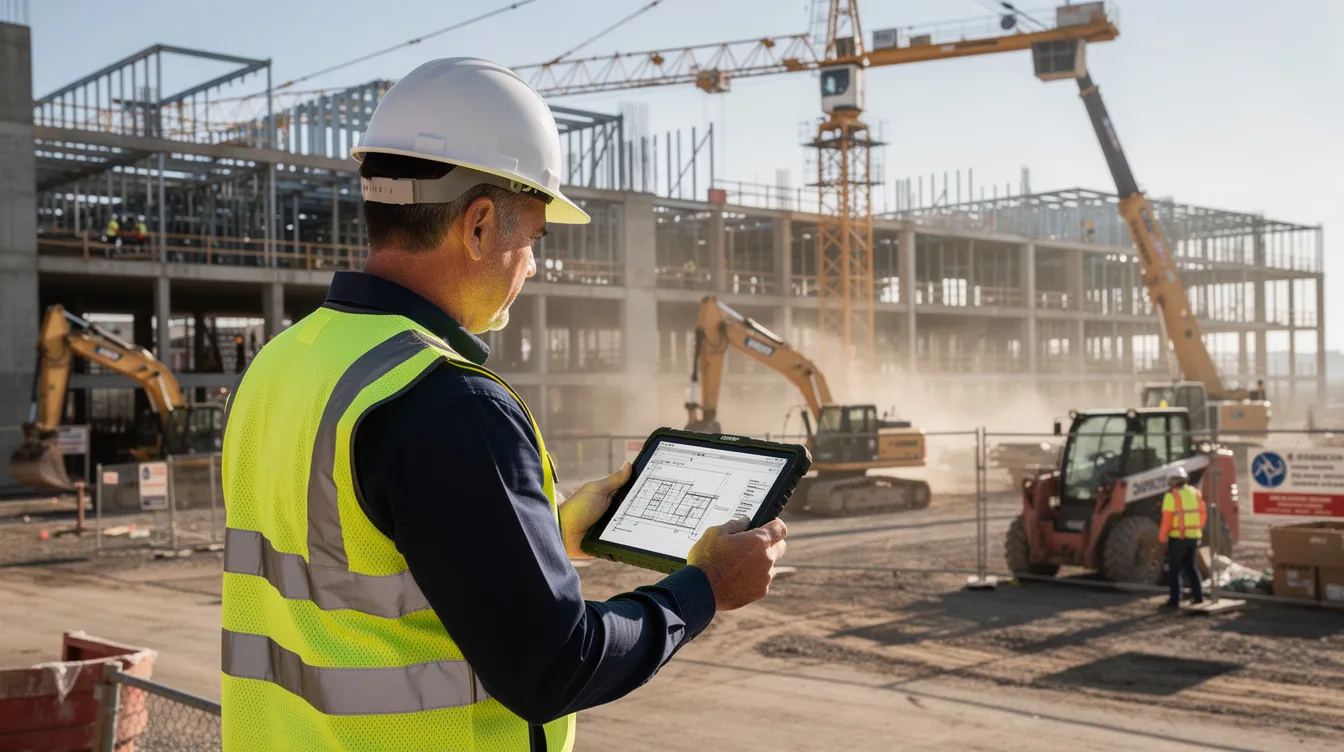
Fleet utilization is usually about comparing available time with productive time. Telematics helps by revealing the gap between a machine being powered on and a machine actually advancing the work. A machine may run all day without delivering a full day of productive output if it spends long periods idling, waiting on trucking, or sitting between tasks.
That is where construction equipment telematics becomes useful as a management tool rather than a reporting tool. If a machine is lightly used on one project while another crew is considering a new rental, telematics can help the contractor make a cleaner redeployment decision. If a machine shows repeated idle-heavy patterns, the issue may not be the machine itself. It may point to coordination gaps, material flow problems, or a mismatch between equipment size and the actual scope.
Here is a simple example. A contractor in the Lehigh Valley schedules an excavator for 50 hours in a week on a grading job. Telematics shows 30 hours of productive work, 10 hours of idle time, and 10 hours tied to nonproductive movement or downtime. That would indicate 60% productive utilization for the scheduled period. The useful next step is not admiring the number. It is asking why 20 hours were not productive and whether dispatch, trucking, crew coordination, or equipment selection should change.
Fuel monitoring can support the same kind of review. Instead of promising a fixed savings percentage, it is more accurate to say that telematics can help contractors identify high-idle machines, unusual fuel-burn patterns, and equipment that may be oversized or being used inefficiently for the task. Contractors still have to act on the information, but the data makes those conversations more concrete.
Connected rental technology changes a basic operating reality: contractors can now have far better visibility into equipment they do not own. Depending on the rental provider and the machine class, telematics may let the contractor see when a rental unit arrived, when it first went into service, how often it ran, and whether it is still being used enough to justify staying on rent.
For Eastern Pennsylvania contractors running rented units across Center City, Bucks County, Allentown, and Scranton at the same time, that can significantly change coordination. Instead of managing equipment mainly through invoices, spreadsheets, and field calls, operations leaders can compare daily use and make more confident off-rent, transfer, and dispatch decisions. Telematics data can also support better conversations with rental providers when the parties need to reconcile delivery timing, pickup timing, or actual use patterns.
Connected rental does not only help the rental company manage its own fleet. It can also help the contractor make sharper decisions about whether to keep a machine on site, move it, service it, or replace it with a better fit. As rental fleets continue adding more connected equipment, the practical question for contractors is becoming less about whether data exists and more about whether their team is ready to use it well.
Eastern Pennsylvania is not one uniform equipment market. Philadelphia and its collar counties, the Lehigh Valley, and Northeast Pennsylvania each create different fleet-management pressures, and telematics can pay off differently in each.
In Philadelphia and suburban Philadelphia, projects are dense, staging space is limited, and equipment moves between sites frequently. After-hours movement alerts, location visibility, and clearer usage history can help contractors respond faster when a machine is missing, misrouted, or sitting on a site where it is no longer needed.
In the Lehigh Valley, especially on large industrial and logistics projects along the I-78 corridor, the payoff often comes from production visibility. Long operating days and large earthmoving scopes make it easy for idle patterns, unnecessary rentals, and fuel waste to accumulate unnoticed unless someone consistently reviews machine-use data.
In Northeast Pennsylvania, where projects may be more spread out across the I-81 corridor and around Scranton and Wilkes-Barre, exact location data can reduce wasted trips for hauling and service. When mechanics, lowboy drivers, or supervisors don’t have to search multiple sites to find the right unit, those time savings add up over a season.
Equipment and vehicle movement remain major struck-by hazards on construction sites. OSHA warns that workers can be struck, pinned, or crushed by construction vehicles and equipment if they don’t follow safe practices. In that context, telematics can support safety by helping contractors monitor equipment movement, review certain operating behaviors, and keep better maintenance and inspection records.
On some covered crane equipment, OSHA’s operator-training and evaluation rule at 29 CFR 1926.1427 requires employers to ensure operators are trained, certified or licensed where required, and evaluated on the equipment they operate, including relevant safety devices, operational aids, software, and the size and configuration of the equipment. That is a narrower point than a general telematics mandate, but it does reinforce a useful principle: when a machine includes digital operating systems or manufacturer-provided interfaces that affect safe operation, employers should account for them in training for the covered equipment.
Still, data is not a substitute for competent supervision, site-specific hazard analysis, operator qualification, or a culture where workers raise concerns about equipment movement and near misses. Telematics is a support layer, not the safety program itself. Eastern Pennsylvania contractors can strengthen that broader system through ABC Eastern Pennsylvania safety resources, including the chapter’s ABC-OSHA Partnership support and related consulting and training services.
Before committing to a connected rental platform or a standalone telematics system, operations leaders should ask practical questions that go beyond the sales demo.
These questions help keep the discussion grounded in operations, not just features.
Many Eastern Pennsylvania contractors are running lean teams and cannot absorb a complex technology rollout in the middle of active jobs. A phased approach is usually more realistic.
Phase 1: Pick one project type and a small group of high-impact machines, such as rented earthmoving equipment on a warehouse project or lifts on a healthcare build-out. Decide in advance which measures matter most to your team, such as productive use, idle patterns, off-rent timing, or maintenance response.
Phase 2: Run a limited pilot for long enough to compare operating patterns before and after the team begins using the data consistently. Assign one person to review the platform, raise exceptions, and turn the information into action. Telematics can support preventive maintenance by flagging engine hours, diagnostics, and service intervals, but only if someone is responsible for using that information.
Phase 3: Review the pilot with operations, field leadership, and estimating. If the data helped the team cut unnecessary rentals, improve redeployment, or respond faster to maintenance issues, then decide whether to expand to more projects, more equipment classes, or tighter integration with your internal systems.
Document your baseline before the pilot starts. Without that step, it is hard to separate real improvement from seasonal workload changes or differences in project mix. Use short supervisor and operator training sessions so field teams understand why you’re collecting the data and how you’ll use it. ABC Eastern Pennsylvania’s apprenticeship and craft training and career development programs can also support broader digital and supervisory skill development as contractors add more technology to field operations.
Construction equipment telematics only creates value when people trust the information and use it to make better decisions. That requires clear expectations, role-based training, and a culture that presents telematics as an operations tool rather than just a surveillance tool.
Eastern Pennsylvania contractors can build that acceptance by giving supervisors simple, repeatable uses for the data: identifying idle-heavy rentals, checking whether a machine is still needed on a finished phase, verifying location before dispatching a truck, or spotting service issues before they disrupt production. Used this way, telematics supports better conversations and better planning.
ABC Eastern Pennsylvania’s workforce development resources and member training infrastructure can help firms strengthen the digital, supervisory, and field-leadership habits that make adoption stick. As construction operations become more data-driven, equipment visibility is becoming part of core management discipline rather than a niche technology experiment.
Construction equipment telematics and connected rental technology are not abstract trends. They are practical tools for improving visibility into rented and owned equipment, supporting better utilization decisions, tightening maintenance planning, and increasing accountability across multiple active jobs. For merit shop contractors working across Philadelphia, the suburban counties, the Lehigh Valley, and Northeast Pennsylvania, the advantage is not simply having more data. It is using better data to make faster equipment decisions.
The immediate questions are straightforward: which rented machines are hardest for your team to track today, where unnecessary idle time or duplicate rentals may be hiding, and who inside your company should own a telematics pilot. Contractors who want additional peer insight, training, and safety support around jobsite operations and technology can explore ABC Eastern Pennsylvania programs and membership resources to keep building those capabilities.


