


The skilled labor shortage in Eastern Pennsylvania is not a warning – it is an open door. Whether you are exploring your first career move or looking to strengthen your company’s workforce pipeline, this guide breaks down exactly how a construction apprenticeship through ABC Eastern Pennsylvania puts you on a direct path to high-paying, in-demand work with zero student debt.

If you are a student weighing options after graduation, a parent researching alternatives to four-year college debt, a veteran transitioning into civilian work, or a career-changer looking for stability and growth – this section is for you. It is also for ABC Eastern Pennsylvania member companies evaluating whether sponsoring apprentices makes strategic sense for their business.
A construction apprenticeship is a paid training program combining on-the-job work with classroom instruction. It is not a part-time gig or an informal mentorship. It is a full time position in the construction industry where apprentices earn a progressive wage while working under the direct guidance of experienced journeypersons and foremen. Mentorship is a key component of apprenticeship programs, providing guidance from experienced professionals at every stage.
ABC Eastern Pennsylvania’s Apprenticeship Trust operates registered apprenticeship programs recognized by both the U.S. Office of Apprenticeship and the Pennsylvania Department of Labor & Industry. Completion of an apprenticeship grants a nationally recognized certificate – credentials that are portable across state lines and respected industry-wide.
Here is what the commitment looks like in practice:
| Component | Typical Requirement |
|---|---|
| Program duration | 1 to 5 years depending on the trade (most building and construction trades programs run 4–5 years) |
| On-the-job training | ~80% of total training time – thousands of hours of hands-on experience on job sites |
| Classroom instruction | ~20% of total training time, including 120 hours of coursework in construction math and safety training |
| Wage structure | Progressive increases, starting at roughly 50% of the journeyman wage |
| Supervision | Direct mentorship from qualified journeypersons |
Apprentices spend about 80% of their training time gaining hands-on experience on job sites and about 20% in classroom training. Over the life of the program, apprentices complete thousands of hours of classroom instruction alongside their field work.
To be classified and paid as an apprentice on Pennsylvania public projects – rather than at full journeyperson rates – individuals must be enrolled in a bona fide registered apprenticeship approved by the Pennsylvania Apprenticeship and Training Council. Informal training or self-taught skills do not qualify.
For people interested in building and construction trades skills but who do not yet have an employer sponsor, ABC Eastern Pennsylvania also offers a Craft Trainee track. This path provides structured classroom and lab instruction to build employability. Once a trainee secures a sponsoring contractor, they can transition into a registered apprenticeship and begin receiving progressive wages and credit toward journeyperson status.
The construction industry has high demand for skilled labor, offering good job security – and that demand is especially acute across Eastern Pennsylvania’s commercial, institutional, and infrastructure sectors. This is not a crisis to worry about. It is an opportunity to seize, whether you are a recent graduate, a veteran, or someone ready to leave a dead-end desk job for a rewarding career in the construction trades.
ABC Eastern Pennsylvania’s Apprentice / Craft Training program covers ten primary trade areas, each with distinct work environments and project types:
| Trade | Typical Work |
|---|---|
| Carpentry | Framing, finishing, formwork on commercial and residential projects |
| Construction Craft Laborer | Site preparation, concrete, demolition, general support across project types |
| Electrical | Power distribution, lighting, controls in commercial, industrial, and institutional buildings |
| HVAC | Heating, ventilation, air conditioning, and refrigeration system installation and service |
| Masonry | Block, brick, stone, and concrete work on structures and facades |
| Pipefitting | Industrial piping systems for process, power, and institutional facilities |
| Plumbing | Water supply, drainage, and sanitary systems in buildings |
| Roofing | Commercial and industrial roofing installation and repair |
| Sheet Metal | Ductwork fabrication, installation, and architectural sheet metal |
| Sprinkler Fitting | Fire protection and suppression systems |
Classes and lab work take place at two modern facilities equipped with industry-standard tools and safety equipment:
Both locations feature hands-on labs designed to mirror real job-site conditions, so the knowledge and skills apprentices develop in the classroom translate directly to the field.
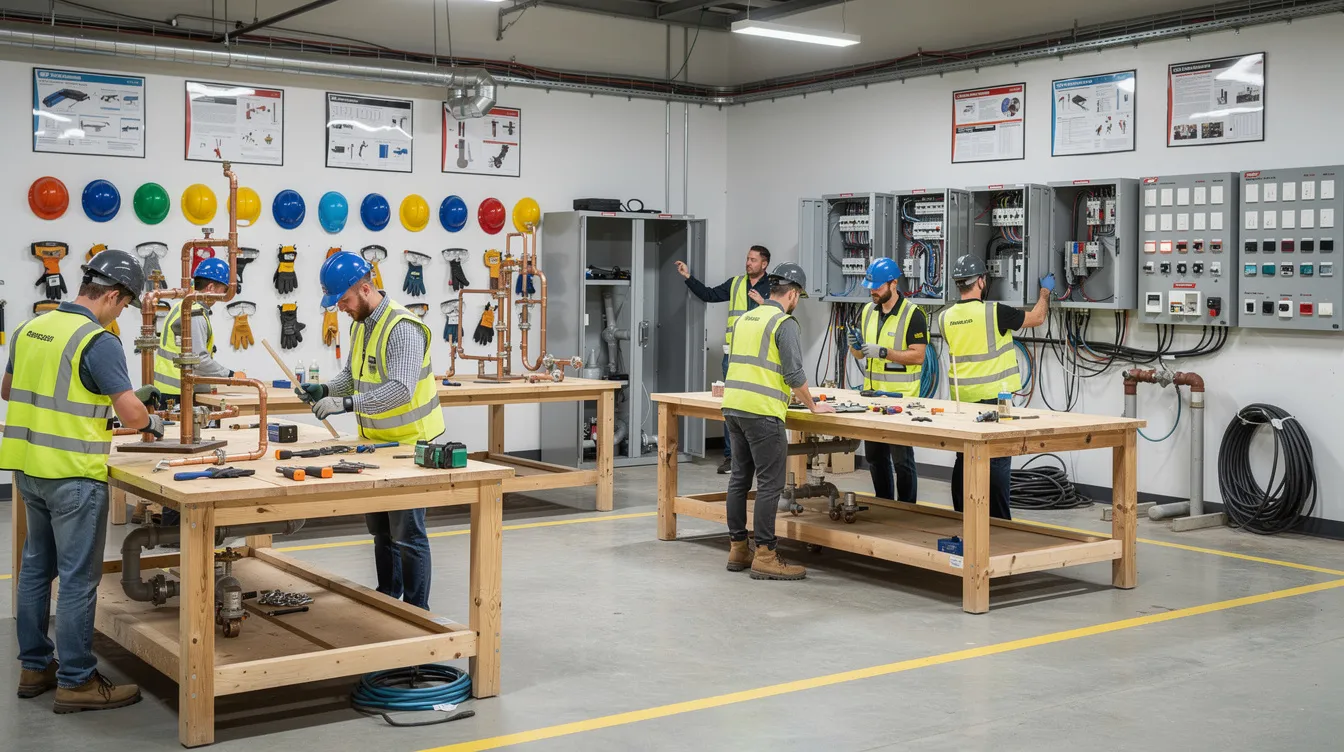
Forget the $80,000-plus price tag of a four-year degree. Apprenticeship programs combine hands-on training with classroom instruction – and apprentices get paid for it from day one. Training costs for apprenticeships are often subsidized by employers or program funding, helping apprentices avoid student debt entirely and graduate with no student loans to repay.
Here is how the wage progression typically works:
Apprentices earn a progressive wage while learning on the job, and upon completion of the apprenticeship, they earn full journeyman wages.
On public work in Pennsylvania, contractors can pay below full journeyperson rates only when apprentices are properly registered. This makes ABC Eastern Pennsylvania’s registered apprenticeship programs critical for employers meeting prevailing wage requirements for apprentices.
The long-term payoff extends well beyond a journeyperson card. Journeyperson advancement unlocks higher base rates and positions apprentices for leadership roles. Apprenticeships lead to varied career paths, including project managers, superintendents, safety professionals, estimators, and business owners. Building a safety-first career in the trades is not a ceiling – it is a launchpad.

ABC Eastern Pennsylvania has been creating opportunities for craft professionals since 1967 – nearly six decades of registered, merit shop training backed by modern labs, experienced instructors, and a safety-driven curriculum. Whether you want to start swinging a hammer or start building your company’s next generation of talent, here is exactly what to do.
Confirm your eligibility. Applicants typically need a high school diploma or GED, must be at least 18 years old, hold a valid driver’s license, and pass a drug screen. Gather your transcripts and any relevant certifications before reaching out.
Understand the application process. Application processes vary by registered apprenticeship program, but generally you can expect to:
Explore in person. Visit open houses at the Allentown or Harleysville training centers. Ask about current demand in specific construction trades, tour the labs, and learn how prior CTE coursework or military experience may shorten your time to completion. Veterans often bring advanced discipline, safety awareness, and applicable technical skills that can be evaluated for credit toward program requirements.
Take the first step. Contact ABC Eastern Pennsylvania’s education team to explore application timelines and start your path. Visit the Careers page for more information on how to begin.
Map your workforce needs. Connect with ABC Eastern Pennsylvania to identify which trades your company needs most, then enroll new hires into the apprenticeship program. Align your internal pay structures with the mandated progressive wage schedule for registered apprentices.
Leverage recruitment tools. The Alliance Partner Consortium provides school partnerships that connect member firms with students at regional high schools and career and technical centers. The Craft Professional Recruitment Committee opens pipelines to military veterans and people from non-traditional backgrounds. Learn more about these and other workforce development resources.
Build retention through transparency. Participation in ABC Eastern Pennsylvania’s apprenticeship program helps firms streamline construction safety training, protect their workforce, and show every employee a transparent career ladder – from entry-level through journeyperson advancement and into leadership. Explore the full set of member benefits to view how apprenticeship fits into your broader business strategy.
Act now. The region’s labor shortage is not going to fix itself. Companies that commit to sponsoring apprentices today are creating the skilled, loyal crews they will need for years of work ahead. Email or contact ABC Eastern Pennsylvania’s team to schedule a workforce development consultation.
These FAQs address common questions that people and employers across Eastern Pennsylvania ask when considering an apprenticeship program. If you have additional questions after reading, reach out to ABC Eastern Pennsylvania directly.
Most building and construction trades programs run 4 years, with some specialized trades running 3 or 5 years depending on on-the-job hours and classroom performance. Apprenticeship programs last 1 to 5 years depending on the trade. Steady attendance, strong evaluations from field supervisors, and passing grades in related instruction keep apprentices on track to complete on time.
Yes. ABC Eastern Pennsylvania can enroll individuals in craft training classes to build skills and employability, even before they secure a sponsoring contractor. Full registered apprentice status – including progressive wages and credit toward journeyperson advancement – begins once the individual is hired by a participating employer and properly registered with the Pennsylvania Apprenticeship and Training Council.
Prior experience is helpful but not required. Many successful apprentices come directly from high school, the military, or entirely different industries. What matters more is reliability, willingness to learn, physical readiness for outdoor work, and a commitment to building a safety-first career. The program is designed to teach you the trade from the ground up.
Veterans often possess advanced discipline, security awareness, and applicable technical skills that can be evaluated for credit toward classroom or on-the-job requirements. If you have military service in fields related to construction, electrical systems, mechanical work, or security, speak directly with ABC Eastern Pennsylvania’s education staff. They can review military transcripts and discuss how to translate your background into a construction apprenticeship program, potentially accelerating your path to journeyperson status.
Tuition and fees are typically handled through a combination of employer support and program funding, so apprentices do not face anything like four-year college debt. Any out-of-pocket expenses – such as books, basic tools, or PPE – are modest compared with traditional higher-education costs and are often offset quickly by apprentice wages. It is worth noting that across Pennsylvania, roughly 26,800 new apprentices have enrolled in recent years under expanded state investment, and the earn-while-you-learn model remains the standard. Set up a conversation with the chapter’s education team to get a specific breakdown for the trade that interests you.


